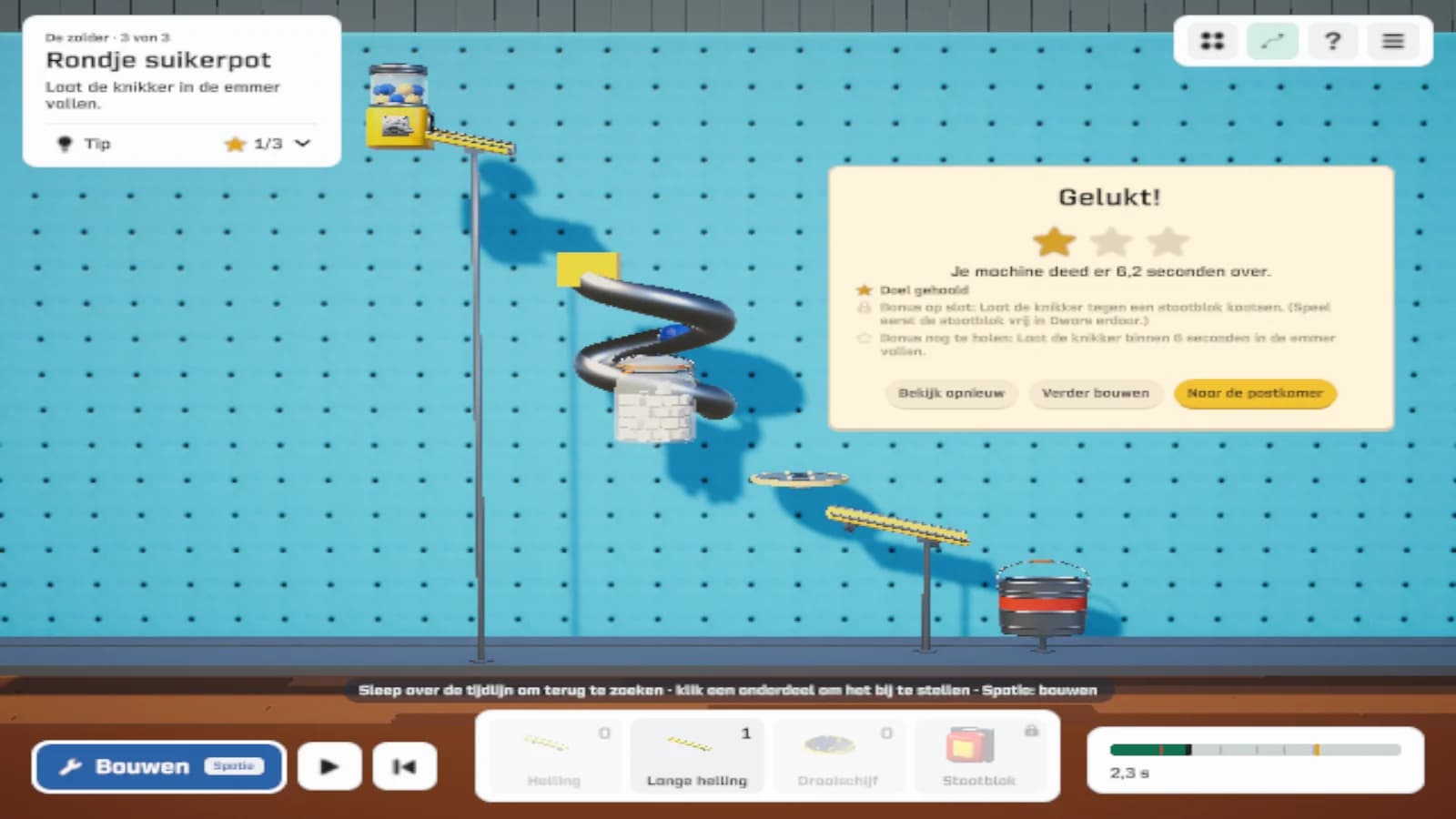
Until now every board was one flat plane. In the attic that changes: the board gets three fixed layers, front, middle and back.
Why three fixed layers
Free depth would turn every part into a 3D placement problem. Three layers are easy to read at a glance, and a part always sits in exactly one layer. The simulation stays 2D per layer, so it's as predictable as ever. Existing puzzles keep working: everything sits in the middle layer.
Parts in different layers don't touch. A marble can roll behind a seesaw without hitting it. That lets you cross routes and build more compact machines.
How it looks
- The front layer is full colour, closest to the camera.
- The back layer is slightly blurred and tinted cool blue.
- While holding a part, the coloured rail of the target layer lights up and the other layers dim. Press Tab to switch layer.
- The camera looks down at a slightly steeper angle, so you see the depth without the board rotating.
Five layer switchers
- Funnel: catches a falling marble and drops it one layer deeper.
- Tunnel tube: a glass tube straight through the board, working both ways.
- Turntable: turns a quarter and moves the marble one layer over.
- Spiral chute: winds around an object, like a sugar bowl, and switches layer on the way.
- Bumper: bounces a marble back hard, the natural partner of the spring and the funnel.
Three intro puzzles
The attic has three short puzzles to learn it: Round the back, Straight through and Round the sugar bowl. After that, layers can show up in other rooms too.
Next time: back to the big rooms, with the quay.